The Blueprint for Enterprise AI: Mastering Context Organization
Context Engineering is the discipline that turns generic AI into a compliant, context-aware business partner. Here is how to structure it across your organization.

On this page ▾
Enterprise AI initiatives often stumble on a hidden hurdle. That hurdle is context. Generative AI models are powerful, but without the right organizational knowledge, they generate generic, unaligned, or even non-compliant results.
To solve this, organizations must move beyond simply giving AI access to data. They need to embrace a new discipline known as Context Engineering.
What is Context Engineering?
Context Engineering is the strategic structuring of knowledge, rules, and preferences that guide AI behaviors across an organization. It is the practice of building a structured, interconnected “brain” for your enterprise AI tools.
Instead of treating context as a massive pool of unstructured documents, Context Engineering treats it as a precise, tiered system. The goal is to ensure that whenever an employee interacts with an AI, the system automatically understands the exact boundaries, policies, and goals relevant to that specific user and task.
The Hierarchy of Context
To organize context effectively at an enterprise scale, you need a clear, nested hierarchy. Based on organizational best practices, this structure operates across four distinct levels:
- Org Level: The foundation. This encompasses overarching corporate policies, universal best practices, and strict compliance requirements.
- Project Level: The operational layer. This includes specific guidelines, rules, and objectives tailored to a particular initiative or product line.
- Team Level: The collaborative layer. This contains localized ways of working, customized preferences, and specific domain knowledge for a defined group of people.
- Individual Level: The personal layer. This captures personal ways of working, user specific preferences, and localized memory.
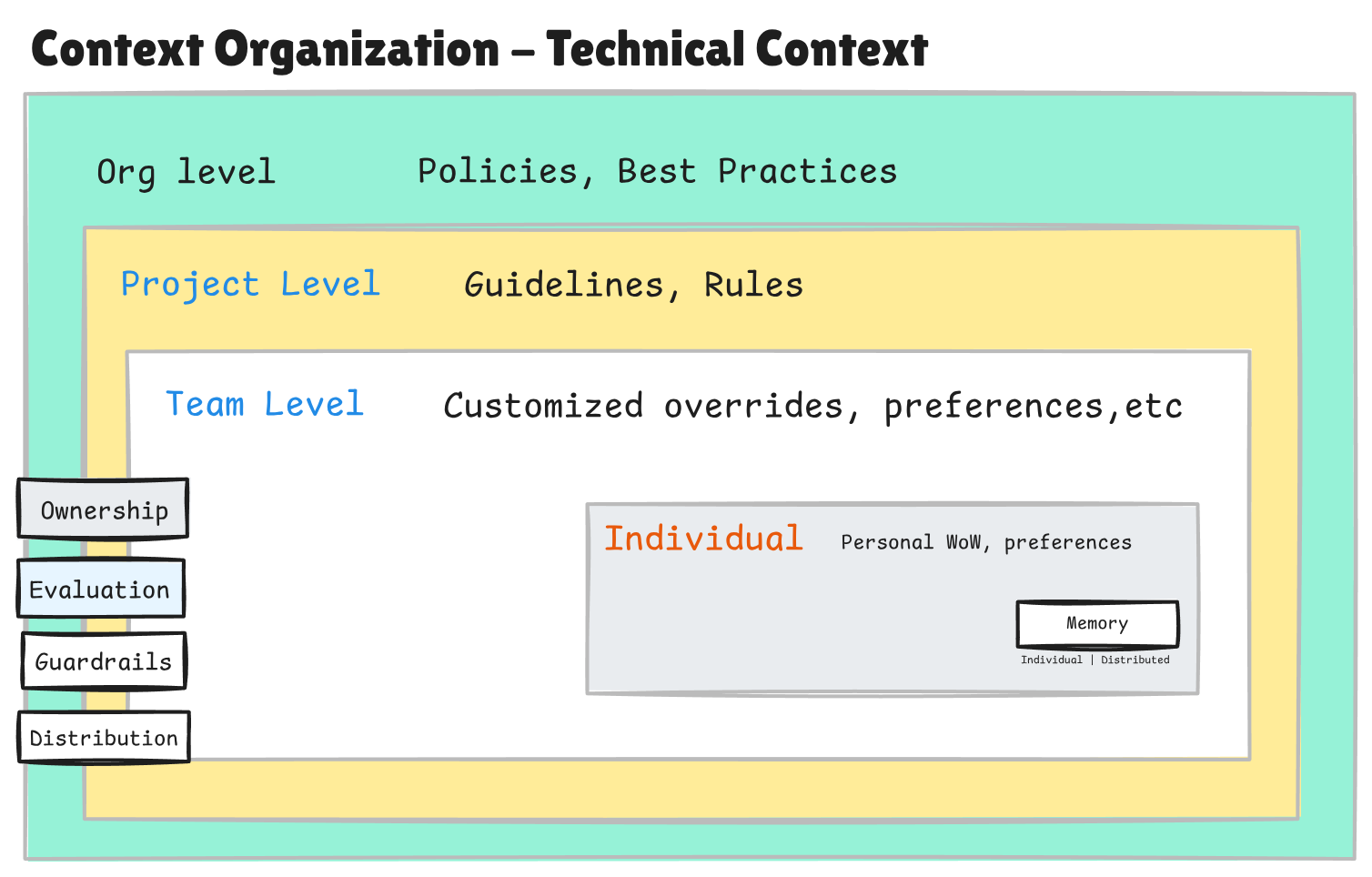 Context Organization for Repository - showing nested hierarchy of Org, Project, Team, and Individual levels with Ownership, Evaluation, Guardrails, and Distribution pillars
Each level nests inside the one above it. The Individual level exists within the Team, which exists within the Project, which exists within the Org. This nesting is not cosmetic. It enforces inheritance and priority at runtime.
The Golden Rule: Hierarchical Priority
A successful context organization strategy relies on strict hierarchical priority. While lower levels provide high specificity, they must operate within the boundaries set by the levels above them.
For example, an individual’s personal AI preferences cannot override team level rules. Similarly, a team’s customized workflows cannot bypass project guidelines, and project rules can never override overarching organizational policies. This strict enforcement guarantees that while AI remains highly personalized and useful to the individual, it never violates corporate compliance or security standards.
The Four Pillars of Context Management
Defining the hierarchy is only the first step. For this ecosystem to function, every single level of context requires active management. We must ensure four key pillars are present at the Org, Project, Team, and Individual levels:
- Ownership: Every piece of context needs a clear owner. Whether it is a compliance officer managing Org level policies or a product manager defining Project level rules, accountability is required.
- Guardrails: Strict boundaries must be established to prevent data leaks, hallucinations, and non-compliant AI behavior.
- Evaluation: Organizations need mechanisms to continuously assess if the injected context is actually improving the AI’s output and accuracy.
- Distribution: The system must seamlessly deliver the right interconnected context to the AI model at the exact moment of execution.
Why This Matters
These contexts cannot exist in isolated silos. They must be deeply interconnected. When an enterprise masters Context Engineering, AI transitions from a generic chat tool into a deeply integrated, highly compliant, and context-aware business partner. By organizing context properly, leaders ensure their AI investments drive real value while perfectly aligning with corporate governance.